
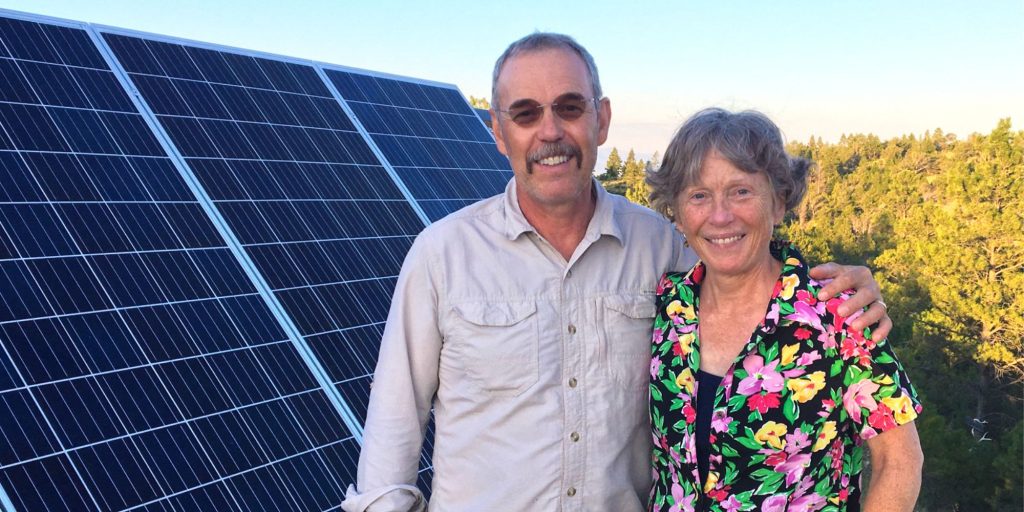
Above: WORC board chair Roxa Reller stands near a solar array with her husband, Mark Reller.
Longtime Northern Plains Resource Council leader Roxa Reller brings tenacity and vision, and a deep sense of place to WORC’s board chair position.
By Eric Warren
As a member-led organization, WORC’s board chair position rotates among our member groups on a yearly basis. For 2026, Roxa Reller has stepped into the chair role. She’s a longtime WORC and Northern Plains board member who, in 2009, helped found Sleeping Giant Citizens Council. She grew up on a small cow-calf operation near Montana’s Upper Rosebud and earned her Range Science degree from Montana State University. For much of her career, Roxa worked on land reclamation and range vegetation monitoring. She has a deep love for ranching, sustainable ag, and the vast beauty of the eastern Montana landscape.
I had the pleasure of chatting with Roxa about why she got into organizing, some of her proudest moments creating positive change in the West, and the importance of rural communities.
Can you tell us a little about your background and what first sparked your interest in community organizing?
I grew up in a quiet country setting where neighbors weren’t too nearby. My siblings and I spent a lot of time outdoors, just walking out the door and exploring for hours — seeing where plants grew, where the water ran, how the hills eroded, and when the spring runoff stopped flowing. That experience gave me a deep curiosity about the landscape and how ecosystems work.
When I was in high school, the Decker coal mines on the Tongue River started. I began hearing about ranchers in eastern and central Montana coming together to ask what strip mining would mean for their land in the long term. What would happen after these massive strip mines move the topsoil and dig out the coal seams, and what would happen to the pits afterwards? That curiosity led me to study earth science, geology, and botany in college. I just felt more at home out on the range.
“It felt powerful to see how organized community voices could influence decisions.”
My first job after college was working on coal mine reclamation. I helped inventory plants, birds, and animals in areas proposed for strip mining. We saw intact ecosystems—sage grouse, songbirds, upland birds, snakes—and it was beautiful. We haven’t gotten to the end of that story about how those landscapes turned out, but it shaped my interest in how communities respond to fossil fuel extraction and how they adapt.
What led you to join the Northern Plains Resource Council?
I joined after attending a house meeting. By that time, I had worked in disturbed mine land reclamation, education, and the cooperative extension in agriculture. I also helped form a watershed group in a very conservative part of Montana. I’d learned a lot about collaboration.
At that meeting, I heard members talk about how Northern Plains works—how people debate resolutions at annual meetings and how every member has the chance to stand up and share their voice in a respectful, democratic process. That really stood out to me. It felt like a place where regular voices were heard and respected, and where those voices could actually influence decisions.
Keep up to date with grassroots organizing in the West with WORC’s newsletter.
This was also about the time that coalbed methane development was taking off. There was so much water being discharged during extraction. Hearing companies say they could pump and move large amounts of water without needing water rights was shocking to me, especially given my work with water law. It felt like Northern Plains was in the right place at the right time to raise those concerns.
Is there a moment in your organizing work that you’re especially proud of?
One highlight from my time at Northern Plains was traveling with other members to Spokane to testify at hearings about proposed coal export terminals in Washington and Oregon. An organizer drove a van across Montana picking up members, and we went together to speak at the hearings.
People came from many places to testify, and Montana showed up in a big way. Going through that process—showing up, following the hearing format, and sharing testimony—really showed me that when people come together, they can make a difference. Those export terminals were never developed, and as far as I know, they’re still shuttered.
It felt powerful to see how organized community voices could influence decisions.
One of the most important things I’ve done since joining WORC’s board is helping create, pass, and now implement WORC’s new 5-year Strategic Plan to build power. Among other things, the strategic plan will enable members to learn fundamental organizing that digs deeper into skills that focus on listening to and organizing our neighbors in order to win the changes our communities deserve — practices like one-on-ones and house meetings. Like Maggie Gordon, Northern Plains’ executive director says, “The more people we organize around shared, commonly felt problems, the more power we’ll have to compel local and state leaders to act.”
What does community organizing mean to you?
To me, community organizing starts with simple conversations—one-on-one talks with people in your community. You ask questions like: What’s important to you? What’s keeping you up at night?
If enough people do that and then come together to share what they’re hearing, you start to see patterns. That can lead to community gatherings where people talk about those concerns together and decide how to act on them. From there, you begin to build collective power that can reach decision-makers.
“Collective power is a kind of synergy—a force multiplier. It’s what happens when organized people come together and speak truth to power. Local voices matter, and when communities stay connected and keep pressing their elected officials, those officials have to respond.”
It’s really about curiosity, listening, and inviting people to participate. That’s what our network organizations have been doing, and it’s time to recommit to that.
How would you describe collective power?
Collective power is a kind of synergy—a force multiplier. It’s what happens when organized people come together and speak truth to power. Local voices matter, and when communities stay connected and keep pressing their elected officials, those officials have to respond.
There’s no guarantee that someone who gets elected will do exactly what they promised, but if enough people stay engaged and keep pushing, decision-makers will start reflecting what communities want.
How does WORC’s new strategic plan help build that kind of power?
The strategic plan recognizes that organized people are the source of our power. It creates the framework for developing leadership within communities — the “secret sauce,” if you will.
It also recognizes the diversity of our region and the many talents people bring. When member groups work together and share their strengths, they become much more powerful than they would be on their own.
What kinds of projects or campaigns have you worked on through Northern Plains?
One of my early efforts involved advocating for energy efficiency in schools. We worked on legislation that would help schools upgrade things like windows, heating, and ventilation systems so kids wouldn’t have to wear their coats in the classroom just to stay warm. We even set up a table at the Capitol with cookies shaped like schoolhouses and apples to talk with legislators about the issue.
Later, I worked on legislation for community solar. The idea was to allow people to subscribe to shared solar arrays and offset their electricity bills. Even after passing both houses, it was vetoed by the governor. But the conversation around community solar keeps growing. There’s just so much power now when I hear people talk about community solar. It just makes me smile, because they get it, that community networks work. We’re doing it in community gardens. We’re doing it in resilient ag. We can do it with community energy production.
“What really excites me is when someone I’ve talked with becomes a leader themselves. When people find their voice and start speaking up in their own communities—that’s inspiring.”
Sometimes change takes persistence and compromise. I think it took three times before we got C-PACE through the legislature and signed by the governor.
Both Northern Plains and other WORC groups are now helping communities wrangle with the spread of data centers. Requirements need to be put in place that allow folks to know what’s happening in their communities. In Montana, members are working on a petition to give to local elected officials. The petition describes steps allowing us to have a place where we urge our local elected officials to implement regulatory protections aimed at shielding Montana ratepayers and our state’s natural resources from harmful impacts related to the development and operation of large load (50MW and above) data centers in Montana.
What motivates you to keep organizing and encouraging others to get involved?
What really excites me is when someone I’ve talked with becomes a leader themselves. When people find their voice and start speaking up in their own communities—that’s inspiring. It’s like a ripple effect. People take their experiences and use them to advocate for change.
I enjoy being part of that process, even in a small way.
What does “resilience” mean to you when you think about rural communities?
For me, resilience is about being a good ancestor. It’s about taking actions today that future generations will be thankful for. That includes protecting soil, water, and ecosystems so food production can continue, and making sure people can still live and work on the land.
It also means standing up for democracy—showing up, speaking out, and participating in the decisions that shape our communities.
What does it feel like when an organizing effort succeeds?
Winning can feel a little unsettling, because it rarely feels finished. There’s always celebration and relief, but there’s also the realization that progress is only part of the journey. You still have to keep going.
What’s giving you hope right now?
One thing that gives me hope is that we still have independent, trustworthy journalism. Journalists continue to ask questions of elected officials and hold them accountable when those officials refuse to respond to constituents.
Knowing that there are people who keep asking for clarity and truth—that gives me hope.


Learn more:
Organizing for Transformation in Nebraska
Grassroots Democracy Shines in the West with 2025’s Electoral Victories
WORC Founder Pat Sweeney Leaves Organization as Senior Adviser

Yes, I want to help WORC elevate Western voices and hold decision-makers accountable!