
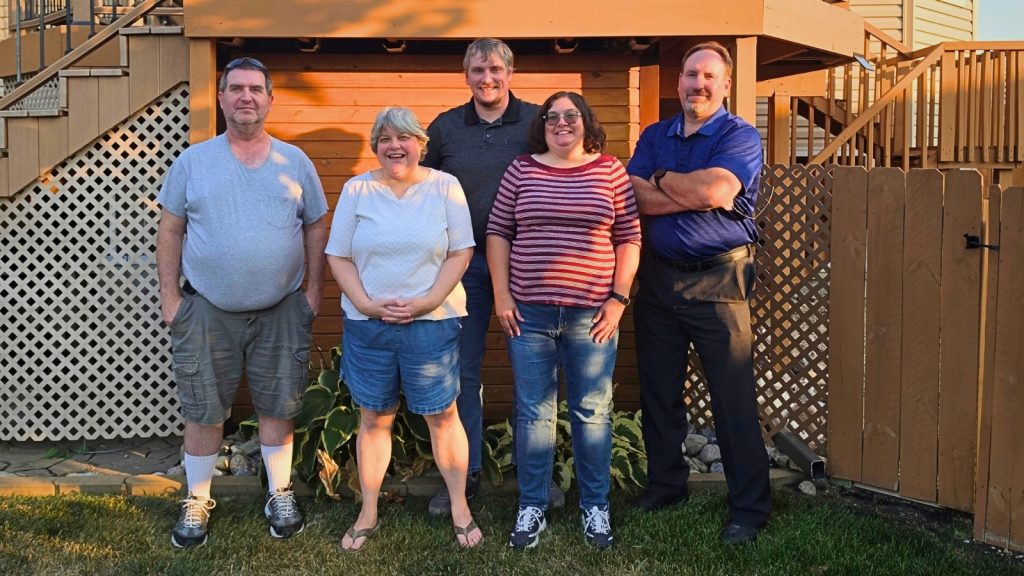
Above: Voices of Harwood – From left to right: Mark Coolidge, Nancy Coolidge, Mike Swartz, Amanda Swartz, and Eric Sinner.
After city officials raced to approve a hyperscale data center in their town without public input, a small community in North Dakota didn’t roll over. They organized.
By Ted Brewer, WORC communications director
On August 18, 2025, Applied Digital publicly announced plans to build a $3 billion, 280-megawatt hyperscale data center in Harwood, North Dakota, a bedroom community of about 800 people just outside Fargo. A week later, the Texas-based company held an open house to present the plan. Hundreds of residents turned out in opposition, worried about the impacts the 160-acre data center (about 120 football fields combined) would have on noise levels, water usage, air quality, utility bills, traffic, and the community’s small-town character.
Despite Harwood Mayor Blake Hankey telling the crowd that the City Council hadn’t discussed the project, a company representative at the open house said the project was already “a done deal.” Hankey did say, however, that the data center proposal was “a good idea” and that the city council would soon meet to discuss zoning changes and permitting to enable Applied Digital to build it.
A week after Applied Digital announced its plans to build in Harwood, the Fargo Forum reported that Hankey and several Fargo city officials, including Mayor Tim Mahoney, signed a non-disclosure agreement with the company in early July before touring the company’s data center in Ellendale, North Dakota. The NDA prohibited them from disclosing Applied Digital’s plans to build a hyperscale data center between Fargo and Harwood. The company had already contracted 900 acres straddling Fargo and Harwood’s extraterritorial jurisdictions, giving it the option to site the project in either jurisdiction or both. The NDAs Fargo’s leaders signed included a clause, added at their request, ensuring compliance with the state’s open-meeting laws. Hankey’s agreement did not include that clause.
Applied Digital initially planned to build at least part of the data center in Fargo’s jurisdiction. Mahoney, however, warned the company against proceeding without first giving affected residents the opportunity to weigh in. A representative of Applied Digital said the company later decided not to build in Fargo after learning it would have to pay franchise fees (which all electricity users in Fargo pay) to help cover the costs of city infrastructure the data center would require, especially roads.
Keep up to date with grassroots organizing in the West with WORC’s newsletter.
On August 4, soon after Applied Digital canceled its plan to build in Fargo and two weeks before the public even knew about the data center, the Fargo City Council voted to annex the 800 acres in Harwood that Applied Digital had contracted for the data center. Mahoney said the council did so because of concerns it had about who would maintain the roads, how the center would access water and electricity, and whether Fargo’s emergency responders would have to answer calls for service to the data center.
On September 2, the Harwood Planning and Zoning Committee and City Council held back-to-back meetings that addressed the zoning changes that would allow the data center to be built in Harwood. More than 100 people showed up, including dozens carrying signs expressing their opposition to the data center. The large crowd prompted city leaders to move the meetings from City Hall to the larger Harwood Community Center.
During the planning and zoning meeting, several residents voiced concerns about how quickly city leaders were moving to greenlight the data center without seeking residents’ input. “This feels too fast,” Harwood resident Alesha Greseth told the committee. The committee nonetheless unanimously recommended that city council approve the zoning change, provoking several people in the crowd to boo and repeatedly shout “cowards” and “shame.”
Michael Swartz, a Harwood resident who was at the meeting, remembers thinking at the time, “Wait a minute. We’re missing several steps on the ladder here. We’re jumping into the deep end of the pool, and nobody even knows how to tread water yet.”
The city council meeting began with more yelling and chaos. Hankey argued that if the city didn’t permit Applied Digital to build its data center in Harwood, Fargo would annex it and Harwood would lose the tax revenue the center would generate. He claimed his constituents supported the project, and those opposed were residents of Fargo, not Harwood. When Harwood resident Swartz took the microphone to speak out against the data center, Hankey quickly cut him off, telling him he could address only the zoning change, not the data center itself. “Let him speak,” several people in the crowd shouted. At that point, Hankey ordered sheriff’s deputies to remove people who were yelling. Two were escorted out. Others left as deputies approached them.
In the end, the council ignored residents’ pleas to push pause on the data center, unanimously voting to approve the zoning changes and building permits. It also voted to oppose Fargo’s annexation of the land, which would force Fargo to request a judicial order to follow through on the annexation. Nick Phillips, executive vice president of external affairs for Applied Digital, said at the meeting the company would also fight Fargo’s attempt to annex the site.
For the data center to move forward, however, the council would have to vote on a second reading. Hankey assured the crowd there would be more opportunities for public comment. That proved not to be the case.
The next city council meeting wasn’t scheduled until October 6, but on September 9, Hankey called a special session for the next day, even though he was vacationing in Portugal. On September 10, hundreds again showed up for the meeting. The city council refused Swartz’s request to move the meeting from the 40-person-capacity city hall to the community center. It also refused to hear public comment. With the mayor leading the meeting from some 4,000 miles away, the council unanimously approved the second and final reading of the zoning change and building permits. The meeting lasted less than 30 minutes.
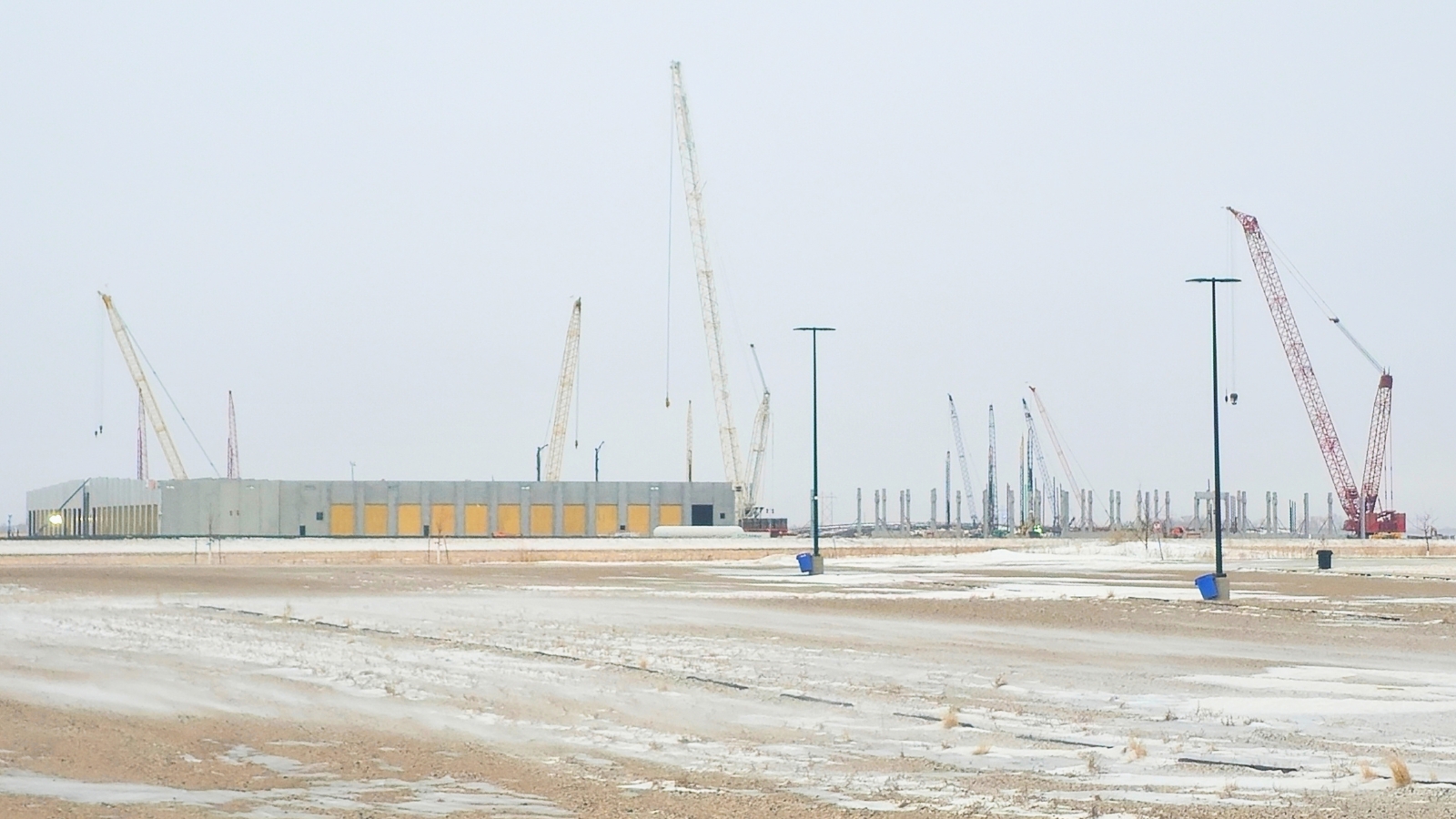
Five days later, Applied Digital broke ground on its data center, called the Polaris Forge 2. In just four weeks, the company had gone from publicly announcing its data center plans to starting construction. It expects to have the data center operational by the end of this year.
“How does that happen?” Eric Sinner, a Harwood resident who attended the city council meetings, asks. “Everybody knows you can’t just call a contractor up to do a project in a month, let alone a $3 billion project.”
“[Applied Digital] had their plan set way before any of us knew what was going on,” Swartz says. “They knew which wheels to grease. They knew how to move things through the system.” He points to the non-disclosure agreement Hankey signed as evidence. “By signing an NDA, you are no longer operating in the capacity of your constituents; you’re working for the company.” (In December, the Fargo City Council, whose members also signed an NDA with Applied Digital, withdrew its attempt to annex the data center property in Harwood.)
Michael Nelson, WORC’s Washington, D.C. campaign organizer, has been researching and tracking the explosive growth of data centers across the U.S. He says Applied Digital’s tactics for getting its data center approved in Harwood followed the playbook data center developers have used nationwide.
“They work as fast and quietly as possible, jamming their data center proposals through the local government approval process before residents have time to evaluate what the impacts might be on their community,” he says. “And if elected officials decide they want to push pause so they can do their due diligence, the companies threaten to move to a nearby jurisdiction where local officials are less likely to slow the process down and more susceptible to the financial carrots the companies are offering.” Harwood proved to be such a place.
Sinner, a resident of Harwood for the past 12 years, says, “[The Harwood City Council] wants the money for the city, and they’re not thinking about anything else. All of the information they considered came from Applied Digital itself. There were no third-party, independent studies to verify or confirm any of that information. The council just bought it.” Sinner, 52, works for a soil inputs firm. He is the son of North Dakota’s late former governor, George Sinner.
“My dad always did what he felt was right,” Sinner says. “But he got independent studies to show that it was right, unlike our city commission, which is like, ‘nope, we’re doing it this way, and that’s it.’ It’s not right to do that to the people you represent.”
At the contentious city council meeting shortly after the data center was announced, one resident suggested the city hold a vote on it. “We have a vote every two years,” Hankey replied, referring to city council elections. Since then, the mayor and city council have argued that because voters elected them, they have the authority to make decisions without public input, even ones as consequential as greenlighting a hyperscale data center.
“City officials come and go,” Swartz says. “It’s a lot harder for residents to leave their entire life behind or uproot because of a hasty decision that changes the atmosphere of the community you thought you were settling into.”
Last year, Applied Digital released a white paper report that “positions North Dakota as the epicenter for AI infrastructure” because its northern climate makes it cheaper to cool data centers than in other parts of the country. Another attraction for data centers is the state’s generous tax incentives, which exempt data center developers from paying the state’s 5% sales tax on computers, servers, cooling systems, and other equipment.
The state’s political climate also doesn’t hurt. In September 2025, the North Dakota Board of University and School Lands, which manages the state’s land and mineral assets, voted to invest $100 million in a data center investment fund. In May, it invested another $100 million in the same fund. The board includes the governor, secretary of state, treasurer, superintendent of schools, and state attorney general Drew Wrigley. Wrigley has come under public scrutiny on Reddit and Facebook for having what appears to his critics as a conflict of interest. A sign with the name of his family’s construction business, Wrigley Mechanical, was photographed hanging from a shipping container positioned next to Applied Digital’s data center in Ellendale, indicating the company was contracted to work on the data center. Sinner says he’s seen the company’s trucks at the Hardwood data center construction site as well. Wrigley’s bio on the North Dakota GOP website states that he “maintains an ownership interest” in Wrigley Mechanical.
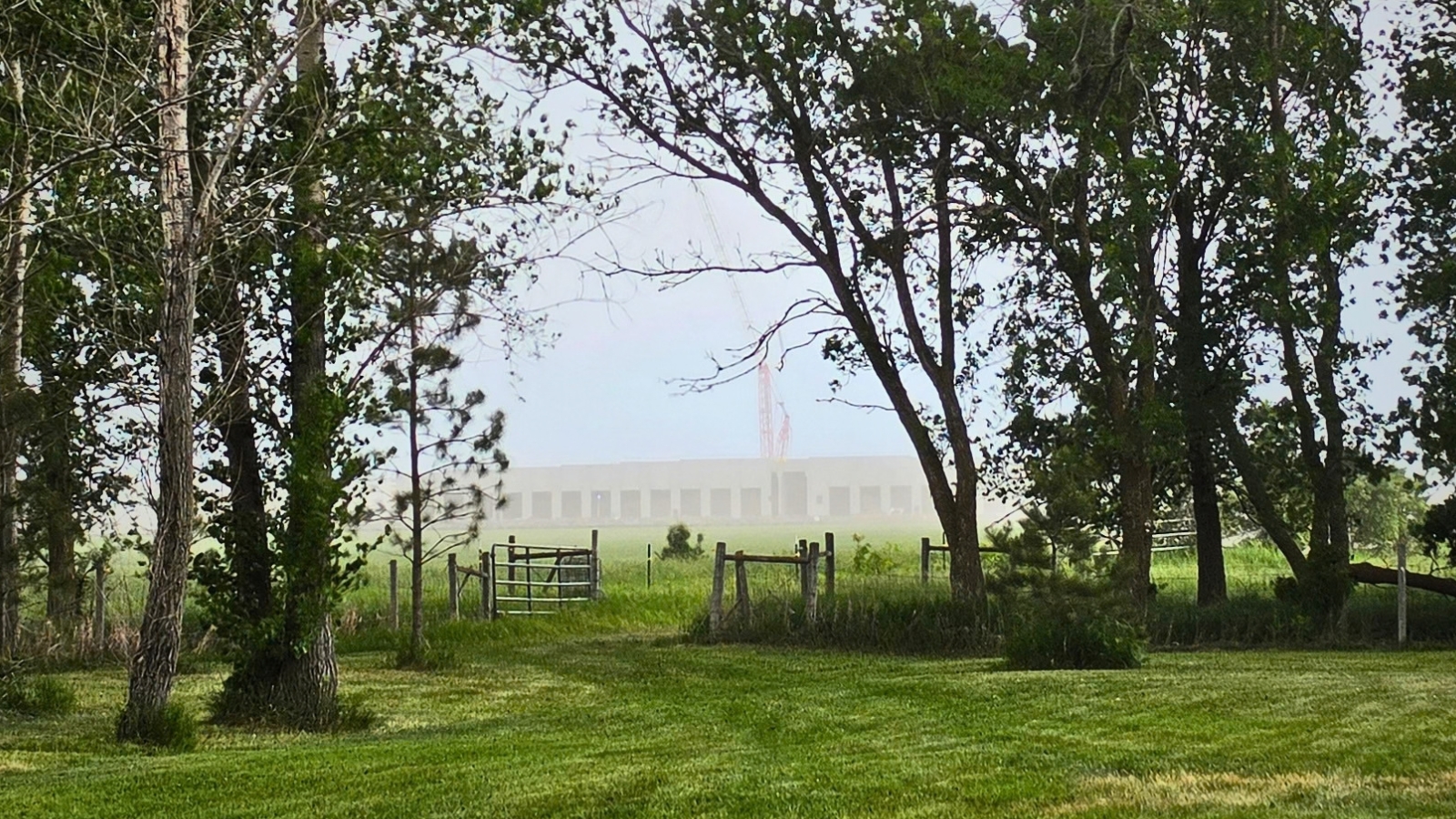
According to the Data Center Map, 23 data centers are currently operating in the state, five of which are hyperscale. Two more hyperscale data centers are under construction—Polaris Forge 2 in Harwood and Polaris Forge 1 in Ellendale, a 530-MW center also owned by Applied Digital and is semi-operational today. The company has also proposed a 430-megawatt data center in Oliver County, in the center of the state.
In March 2026, after hearing from several residents who demanded that the county do its due diligence before greenlighting the data center, the Oliver County Commission approved a 180-day moratorium to give the county time to assess the potential impacts. Three weeks later, the commission voted to repeal the moratorium. The next day, Applied Digital submitted a rezoning application to the commission to allow for the construction of its data center.
The fast-tracked approval of Applied Digital’s data center in Harwood and the abrupt lifting of the moratorium in Oliver County have fed a widespread belief among North Dakotans that elected officials, acting in coordination with representatives from data center and energy companies and in fear they may be sued if they don’t comply with the companies’ demands, are actively blocking the public from having a say on the future of their communities and their state. Some farmers and ranchers feel particularly imperiled, fearing that data centers and the energy infrastructure needed to power them will eventually blanket the state, as landowners sell out to developers rather than rent their land to farmers, and power companies use the threat of eminent domain to force farmers to sell their land or grant easements. “We’re scared,” says Michael Berg, who farms in Oliver County. “We’re scared for our future and what it’s going to look like.”
“It’s not just our lives that are impacted by this,” Swartz says. “It’s every generation from this point on. Everybody’s so focused on the here and now and the dollars we’re going to take in, but we don’t know what we’re doing to our area or the impact that’s going to have downstream. Nobody’s even thinking about that.”
Swartz, a software developer, and his wife Amanda moved to Harwood from Fargo in 2007. They built their home there and settled into a comfortable, small-town life that has suited them and their two children. What concerns him most about the data center is losing “what I settled into Harwood for, basically the proximity to the town and the residents,” he says. “I am also really fearful about the noise pollution, the light pollution, the potential for air pollution.”
About a week after the Harwood City Council approved the data center, Ishauna Jacobberger, an organizer with Dakota Resource Council (one of WORC’s member groups), called Swartz. “I did my best to make sure he felt like there were options and folks in Harwood weren’t alone, and didn’t have to go out without a fight,” she says. Jacobberger went on to hold one-on-one conversations with more residents, including Eric Sinner, to see how they wanted to respond. A mix of Democrats, Republicans, and Independents, the residents decided to unite and organize under the name Voices of Harwood, with DRC’s Jacobberger serving as their consultant and organizer. The group began meeting weekly at the Swartzes’ house. Swartz quickly emerged, in Sinner’s words, as Voices of Harwood’s “driving force.”
“This is so far out of the wheelhouse of comfort for me,” Swartz says. “I never thought that I’d be leading the charge in a self-defense movement like this, because that’s what it feels like. It feels like I’m on the front lines of trying to protect my community from an invader that’s going to change everything I know about my life, my family, my property. It’s an undertaking that I never thought I’d have to realize.”
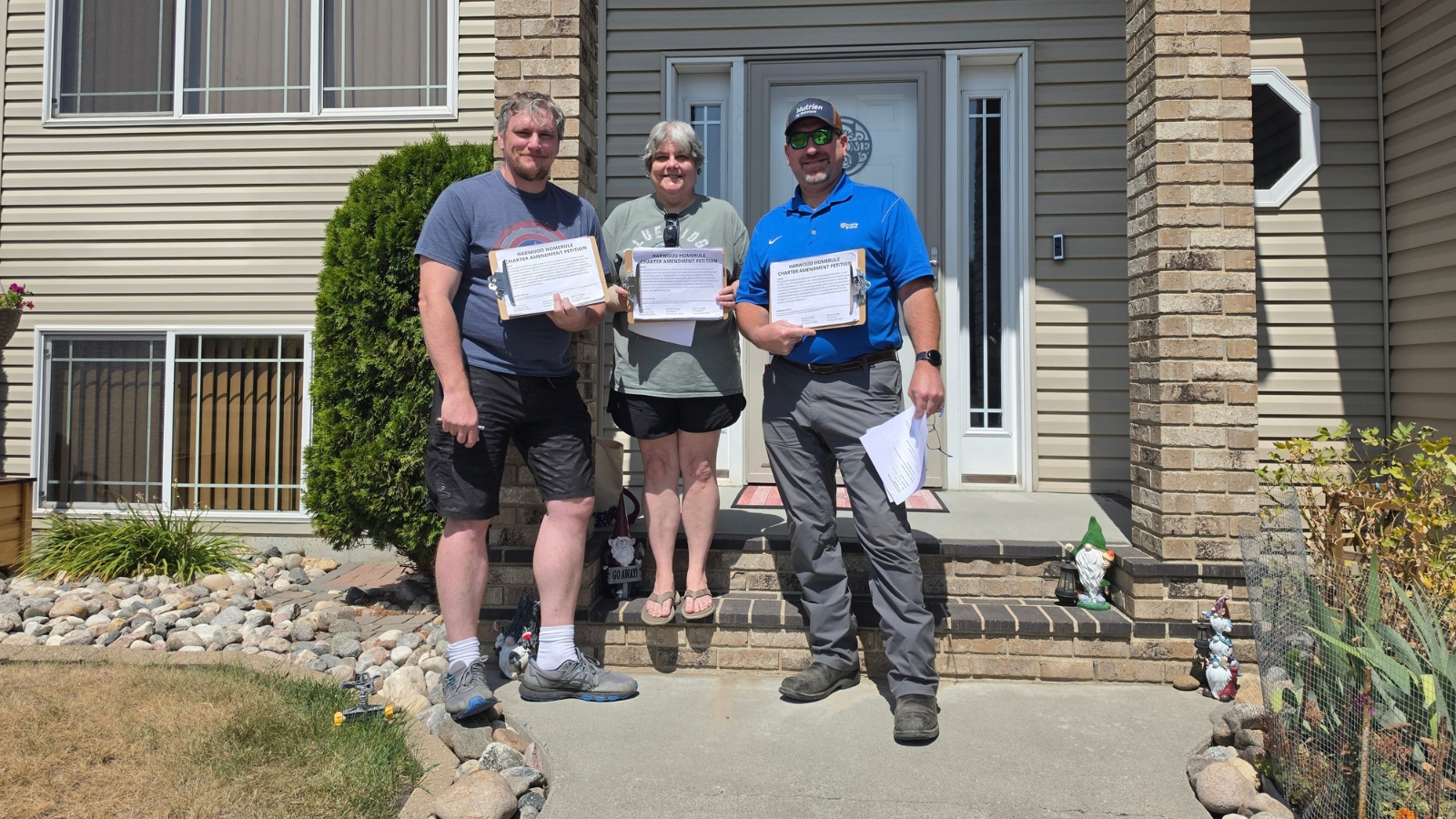
One of the team’s first decisions was to create an online survey asking Harwood residents for their opinions on the data center, the approval process it underwent, and their concerns about how the center would operate. The team then sent more than 500 postcards to Harwood residents (around 75% of all households in town), with a QR code linking to the online survey and details about an information-sharing meeting the team planned for February.
After sending out the postcard, team members canvassed the town, talking to more than 30 residents and asking the same questions as were on the survey. “We had lots of good conversations with people about the data center and how the decisions were made, and we did it in negative-20, negative-30-degree weather, which was very character-building,” Jacobberger says, laughing. In total, more than 70 Harwood residents took the survey, either online or in conversation with the canvassers.
With the survey results in hand, the team prepared for its information-sharing public meeting on February 9. So they would have additional information they could share with residents at the meeting, Swartz sent Applied Digital a letter on January 16 with 26 detailed questions based on the concerns residents had expressed about the data center, specifically about power consumption, water usage and storages, emissions from the 192 generators the center would use when the power went out, and how big the center could eventually become.
The questions about the data center’s expansion stemmed from the fact that Applied Digital had contracted 900 acres of land for a data center campus it said would cover only 160 acres. It also stemmed from a press release the company had issued in October 2025 stating that the company had given right of first refusal to a “U.S.-Based Investment Grade Hyperscaler” for “an additional 800 MW of critical IT load at the [Harwood] campus—representing the full 1-gigawatt expansion potential of the site.” A full gigawatt equals about half of what the entire state of North Dakota consumes at any given time and is nearly three times the amount of power Applied Digital told the council it would use when it got approval for the data center.
While Swartz waited for Applied Digital’s answers, town residents received another postcard in the mail inviting them to a different data center information-sharing meeting, this one organized by Applied Digital. The postcard looked nearly identical to the one Voices of Harwood sent. The event, moreover, was to be held at the same hour, on the same day of the week, and in the same place as Voices of Harwood’s, only a week later. Jacobberger and Swartz suspected Applied Digital was intentionally trying to confuse residents and lower turnout at the Voices of Harwood and DRC event.
The company also delayed sending its answers to Swartz’s questions. It didn’t respond until minutes before the information-sharing meeting started, so he didn’t see the email until after the meeting. But it mattered little, because the response he received was mostly a regurgitation of the talking points the company had been using since announcing the project, leaving unanswered questions residents had about the amount of emissions the generators would produce, about air monitoring, water storage, and the company’s plans to expand the data center.
Despite the confusion caused by Applied Digital’s plan to hold a separate community meeting a week later, more than 100 residents turned out for the Voices of Harwood meeting. At the meeting, Swartz shared the survey results showing that 47% of the town’s respondents did not support the data center decision or how it was made; 9% supported the decision but not how it was made; 21% supported the decision and how it was made; and 13% were unaware of the decision. (The remaining 10% gave single, indeterminate answers.) A vast majority of respondents expressed little to no confidence that the city government and Applied Digital would be transparent with them.
“It was important for us to help people who might oppose the data center not feel alone and know that other people had questions about it, didn’t like the process, and cared about the future of their shared community,” Jacobberger says.
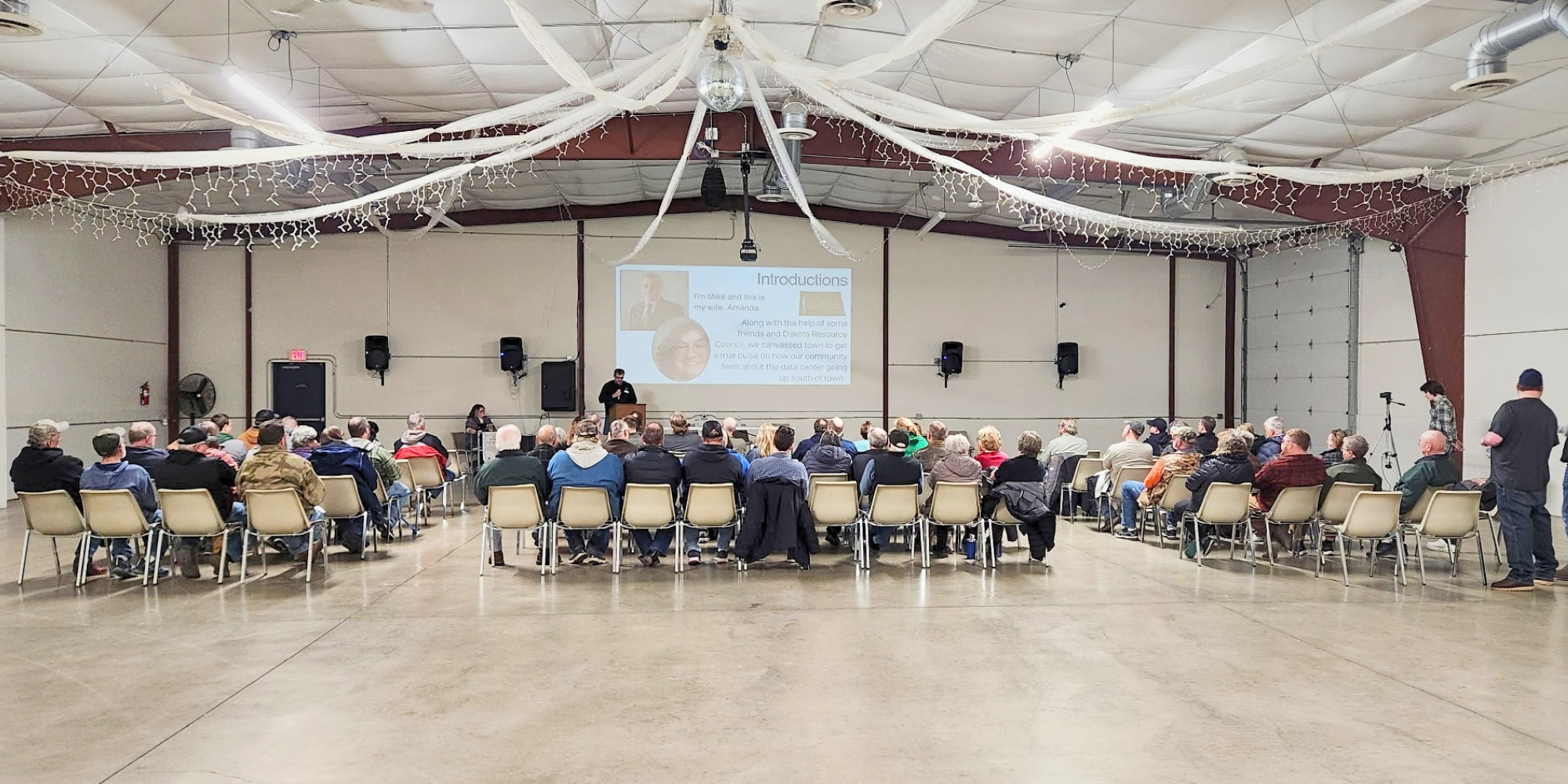
“We can’t roll back on what’s been agreed to,” Swartz says, “but we know for sure that [Applied Digital] is going to try to expand the center, and maybe triple the size that it currently is permitted for. So, what can we do as a community to put safeguards and safe practices in place? How can we get some reassurance that our community is still going to be here should things not go exactly as pie in the sky?”
At the meeting, Swartz announced that Voices of Harwood would work on an ordinance to propose to the mayor and city council that addresses residents’ concerns about the data center, its potential impacts on the town, and Applied Digital’s plans to scale up. He then invited attendees to add their names to a sign-up sheet if they wanted to help draft or endorse the ordinance.
After the information-sharing community meeting in February, a vocal supporter of the data center walked up to Swartz, shook his hand, and said he respected all the work and energy he had put into making sure the data center didn’t harm the town. That meant a lot to Swartz and Jacobberger because it suggested that residents who support the data center might also be open to supporting its regulation.
“After seeing that and hearing feedback, we thought if we could work to protect the community from rampant expansion, overuse of resources, and rising electricity bills while also allowing the data center to do its business, it could be a win-win situation for everyone involved,” Jacobberger says.
After the meeting, the Voices of Harwood team, Swartz in particular, got to work drafting the ordinance language, basing it largely on ordinances other cities and townships have passed to regulate data centers and other large industrial projects. The ordinance also reflected input Voices of Harwood received in conversations with residents during its winter canvassing.
A problem with the ordinance quickly became apparent. A friend of Jacobberger who works for the League of Women Voters told her that the Harwood City Council could always overturn an ordinance—if it ever voted to enact it—with a simple majority vote. So the team unanimously decided to change course and launch a ballot initiative to amend the town’s home rule charter. If passed, the amendment couldn’t be revoked by a city council vote; only another popular vote could.
In its final version, the amendment sets clear guidelines for how the city addresses large industrial projects—including any significant expansion of the data center— that meet certain thresholds for electricity and water use, land size, power generation, and air emissions.
It would require the city to gather reliable information about the project and, when necessary, contract an independent expert to review the project’s potential impacts on city services, including potential costs if the facility eventually closes. (The cost for those independent reviews would fall directly on the developer, not on local taxpayers.) Residents would receive advance notice, access to information, and ample opportunities to share their concerns. The city would, finally, have to provide detailed documentation explaining the decision-making process for approving or rejecting the project.
After Voices of Harwood finished a first draft of the amendment, members brought it to the city council for feedback and to see whether they could find a middle ground between what the group wanted and what the council wanted. At a council meeting on June 1, the first person to speak about the amendment was Jannelle Combs, a lawyer for Applied Digital.
She wasted no time smearing the Voices of Harwood amendment, suggesting it was written entirely by AI. (Without the funds to pay for legal assistance, Voices of Harwood has used AI to hone and refine the amendment so it passes legal muster, but the process it lays out for the city council to approve large-scale industrial projects comes from the input they’ve received from town residents and the extensive research Swartz has done on similar amendments. “It’s not so much we’re against AI,” Swartz says. “It’s just that the decision-making process for data centers is seriously flawed.”)
Combs rightly noted that the Voices of Harwood’s amendment did not align with how charter amendments are usually formatted (something Swartz corrected in its final draft, with the help of AI), then claimed it would violate the Fifth Amendment of the U.S. Constitution and require Applied Digital to apply for a federal environmental impact statement for something as minor as a new shed. She also said that if the amendment passed, it would indicate the city did not want to see any more data centers built in its jurisdiction. She implied that Applied Digital would simply have to go to the jurisdiction over, meaning Fargo, to expand, which would mean the city losing out on the tax revenue the expansion would provide.
Combs spoke for nearly four minutes. The city’s legal representative, Sarah Wear, spoke for less than one, saying only that she had “concerns” about the amendment, which she noted in written comments to the city council. She did not say what her concerns were or whether they aligned with Combs’.
Having witnessed Combs at a number of local meetings across the state, Jacobberger has seen a certain power dynamic play out. Combs appears to, at times, fill the role of legal counsel to elected officials when they’re deliberating on decisions that would apply to Applied Digital’s data centers, with elected officials paying a questionable amount of deference to Combs’ input. She points to an Oliver County Commission meeting on July 7 that shows commissioners asking her what language is acceptable to Applied Digital and editing their language based on how Combs responds. At times, they rely on her rather than their own legal counsel to interpret applicable state laws.
“The way the process plays out between our elected officials and corporate interests can really make you wonder: who exactly are our officials accountable to, the people they are elected to represent or companies like Applied Digital?” Jacobberger says. “Something I hear frequently from pro-data center people is that citizens vote their officials in; therefore, we just need to trust them to do their job. When we continue seeing how easily elected officials dismiss community concerns and prioritize corporate interests, it raises real questions.”
After hearing from Combs at the Harwood County Commission meeting, Hankey said, “I would be a no” on having the council back the amendment. “It’s self-serving of me to say this, but we’ve been through this. We have elected officials. Those elected officials are trusted by the people to make the best decisions they can for the city. Obviously, that was put to task with all of the public meetings we had.”
Swartz later spoke up in defense of the charter amendment, reminding the council, “a good percentage of the population felt blindsided by Applied Digital coming in and us not knowing what was going on,” and that the charter initiative would prevent that from happening again. He also pointed out, as a practical matter, that the city should favor having data centers post bonds to protect the city from reclamation costs if the AI industry collapses and the data center is abandoned.
“We’re looking for more protections than we currently have, more than just a gentlemen’s agreement,” he said. He also pointed out that, despite repeated assertions that Applied Digital had no current plans to expand, Combs had just warned that the ordinance would force the company to go to Fargo to expand.
Not surprisingly, the council swiftly dismissed the charter initiative without a vote. After the meeting, Swartz approached Wear, the city’s legal representative, to hear her concerns about the ordinance. According to Swartz, she refused to share them, telling him she could not comment unless the council asked her to.
For his role in pushing the city to put restraints on the biggest industrial development in the town’s history, some council members have tried to paint Swartz as a troublemaker, something that doesn’t sit well with him. “I’m trying to save my home,” Swartz said. “And then to have members of the city council say that I’m just causing trouble because I care about the livelihood of this town is really another gut punch, like the one we got when they agreed to this [data center] deal, and nobody knew anything about it.
“I never thought I would be engaged in this kind of confrontation over common sense with my elected leaders,” he added.
After the city council meeting, members of the Voices of Harwood took a few weeks to lick their wounds and reassess the situation. When the group met in June, they decided to move ahead with the charter amendment anyway, first by revising its format and some of its content so it could better withstand any red flags the city auditor might raise to disqualify it from being on the ballot, a distinct possibility. The group needed only 40 signatures to get it on the ballot, but set a goal of 80 in case the city auditor found any signatures to be invalid.
The group planned to start gathering signatures on August 1 at Harwood-A-Rama, the city’s annual festival. It applied to the city for permission to set up a table at the park where much of the festival would be held. But the city denied the request, saying it conflicted with the interests of one of the event sponsors—Applied Digital. Hearing this, one of the Swartzes’ neighbors offered to let them set up a table on her lawn, which faced the street where the festival’s car show would be held. That meant the group could still draw the attention of people attending the festival.
At the festival’s kick-off event, a pancake and waffle breakfast at the Community Center, the Swartzes had just arrived to gather signatures from people who were leaving the breakfast (they thought it impolite to bother people heading in) when one of their neighbors, a man with a familial connection to someone in city government, pulled up next to them. He was obviously incensed to see the Swartzes there with a sign in the back of their truck that said, “Voices of Harwood—your voice, your choice.” According to the Swartzes, the man launched into a five-minute tirade, threatening to call the police and have the couple arrested for being in the parking lot (even though it was public property). He accused them of trying to shut Applied Digital down and told them they could just move somewhere else if they didn’t like the data center. His parting words were “f*** off and die.” (He later apologized to the Swartzes.)
Three members of the Harwood City Council also spoke out against the charter amendment, claiming it would impose heavy administrative burdens on the city and blow a hole in the city budget, even though the amendment explicitly states that project sponsors would bear the cost of any independent project assessments.
“That drives me nuts,” Sinner says. “They’re misleading people, saying it’s going to cost us a lot.” He thinks the city council is so adamantly opposed to the amendment because, “they’re proud of their decision [to permit the data center], and, in any case, I don’t think they want to admit they were wrong.”
Council members have also argued that it would prompt Applied Digital to seek de-annexation of their land from Harwood and encourage Fargo to annex it, which seemed far-fetched to Swartz and others in the group given the contentiousness between the company and Fargo’s leaders and Applied Digital’s reluctance to pay franchise fees to operate within the city’s jurisdiction.
Despite the opposition from the mayor and city council, Voices of Harwood collected 91 signatures in three days. But the amendment still needed city auditor Chayla Hansen to verify it before it could go on the ballot. From what Swartz could gather from the North Dakota Century Code, she had up to 30 days—until September 4—to do so.
Meanwhile, opposition to the amendment ratcheted up. A group calling itself Concerned Citizens of Harwood organized a public meeting to discuss the amendment. They scheduled it to occur two days before Vern Thompson, a candidate for the state’s agriculture commissioner who’s been outspoken in his opposition to the unregulated expansion of data centers, was set to speak in Harwood. The group dropped a flyer at several residents’ doors informing them of a meeting. It read, “The main target of this amendment is resistance and any future progress of Applied Digital but, if approved, affects every significant project proposed for Harwood’s future” [sic].
Because Swartz rented the Community Center on Thompson’s behalf, he thinks the opposition mistakenly believed Thompson’s event would focus on the amendment and scheduled their meeting to preempt it and get their message out first.
Swartz, his wife Amanda, and other members of the Voices of Harwood attended the Concerned Citizens meeting, as did three of the city council members, who insisted again that the amendment was going to cost the city money and force them to hire new staff (without acknowledging that it applied only to large-scale industrial projects and that the project sponsors would have to bear the cost of any independent impact assessments, not the city. Nor would the city have to conduct those assessments since they’d be contracted to a third party.)
“It was pretty much a rally of the city council and their staunchest supporters,” he says. “But there were others in the audience who wanted to know more about the amendment.” Swartz was invited to answer their questions, but could only get a few words out before someone in the audience interrupted him.
The September 4 deadline for the city auditor to verify the amendment came and went, and still no one knew for sure what her decision had been. On September 8, a story appeared in the Fargo Forum reporting that she had turned the amendment petition in to the election board so it could be added to the November ballot. Predictably, Harwood’s mayor and one of the city council members criticized the amendment as being cost-prohibitive. Notably, however, City Attorney Sarah Wear declined the Forum’s request to share her legal opinion of the amendment.
“That suggests to me that she doesn’t want the opinion to be made public because it may not support the city council’s reasoning for opposing the amendment,” Jacobberger says.
A few weeks after Voices of Harwood learned that its amendment would be on the ballot, an unexpected challenge emerged. Cass County (where Harwood is located) released its ballot sample with a summary of the amendment that read nothing like the one Voices of Harwood had submitted to the city auditor. The language on the ballot version was far less neutral and factual, and more charged and speculative, than the language Voices of Harwood used in its summary. The ballot version says the amendment “would impose additional significant requirements” and “place new limitations and obligations” on the city—language that echoes criticism city council members have used against the amendment. On a recent episode of a local radio talk show, Hankey admitted that the city attorney, Wear, drafted the ballot summary. She had not given Voices of Harwood a chance to review it.
So voters get the right information and will vote for the amendment, the group plans to talk with neighbors, send out mailers, write opinion pieces for local news outlets, and appear on any talk radio shows interested in having group members.
Regardless of whether the amendment passes or not, the members of Voices of Harwood have made their voices heard, not just in Harwood, but across the state. Their experience of being left in the dark while their mayor negotiated, in secret, a project that would have an enormous impact on their lives and change their town forever, rippled across the state. It prompted Democrat state Sen. Tim Mathern of Fargo to sponsor a bill at a special session of the North Dakota State Legislature this summer to ban nondisclosure agreements between government entities and developers of data centers and other industrial projects and put a two-year temporary moratorium in place to give the legislative body time to work out some guardrails. “Secrets destroy trust in government,” Mathern said before the nondisclosure agreement bill went to vote.
Both bills failed in committee, however.
“People in North Dakota are finding that money and power have more say than residents do,” Jacobberger says. “North Dakotans across the state are hungry for real change that directly protects their home, neighbors, and communities. If elected officials want the trust of the people they serve, then they have to start listening to them.”


Learn more:
Meet Roxa Reller, WORC’s 2026 Board Chair
Did North Dakota Regulators Hide an Oil and Gas Industry Spill Larger Than Exxon Valdez?

Yes, I want to help WORC elevate Western voices and hold decision-makers accountable!