
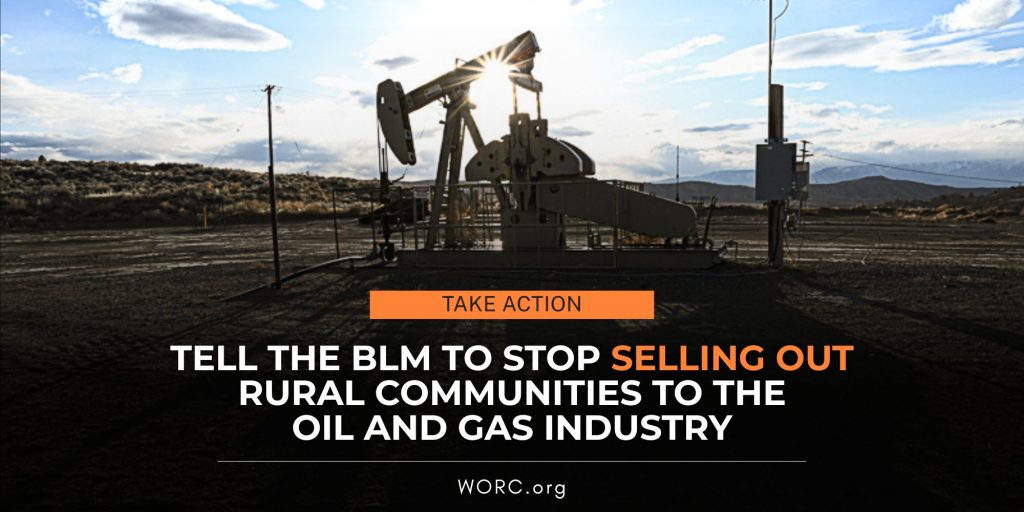
Sec. Burgum continues to give oil and gas companies what they want, no matter the cost to the public and rural communities.
By Sarah Hunkins, WORC Washington D.C. Representative
On June 24, 2026, the Department of the Interior and the Bureau of Land Management (BLM) under Sec. Doug Burgum proposed a revision to the 2024 Oil and Gas Rule, which the public can formally comment on now through August 24, 2026.
This revision would do multiple things that threaten the health and livelihoods of rural Western communities, especially ranchers. Among the provisions, there are three that are particularly egregious. They would:
- Reduce bonding rates and thereby incentivize oil and gas companies to leave toxic messes that taxpayers, states, and landowners would have to pay to clean up.
- No longer require the government to notify split-estate landowners when the BLM decides to offer a lease for the federal minerals under their properties.
- Severely reduce the amount of time the public is allowed to comment on any oil and gas lease sale.
Some background on bonding rates
In 2024, the Bureau of Land Management passed a new Onshore Oil and Gas Rule that finally raised the bonding rates that oil and gas companies pay to drill federally owned minerals. Before then, the rates were so low that companies were incentivized to simply forfeit the bonds they paid, because the bonds were significantly less than the actual costs of plugging wells and rehabilitating the land and water around them.
With this revision, bonding rates would return to what they were in the 1950s and 60s. That means oil and gas companies would only have to pay a $25,000 bond for all of their leases in one state, whereas now they pay $500,000. For drilling on one lease, companies would pay a mere $10,000 for a bond, whereas they now pay $150,000.
The BLM has reported that plugging a well and reclaiming the land costs, on average, $71,000 per well and, in some cases, up to $200,000. Of course companies would choose to forfeit the bond rather than pay the actual costs of cleaning up after themselves.
Rolling back bonding rates would only exacerbate an already gargantuan problem. There are currently an estimated 2.6 million unplugged wells across the country leaking methane, benzene, and other toxic substances that sicken people, pollute air and water, and do untold harm to wildlife. The rollback of bonding rates would almost certainly lead to more.
You can read more about the threat these unplugged and abandoned wells pose a threat to rural communities here.
Making companies pay to clean up their toxic messes is a no-brainer among Westerners. Colorado College’s 2026 Conservation in the West Poll found that 90% of Coloradans, 95% of Wyomingites, 95% of Montanans, and an average of 90% of people across the West support a requirement that oil and gas companies, rather than taxpayers, pay for all of the clean-up and land restoration costs after drilling is finished.
A slap in the face of split-estate landowners
Split-estate landowners are people who own the rights to the surface of their property but not to the minerals beneath it, such as oil and gas. Those rights belong to the federal government, and the BLM can lease those minerals to private oil and gas companies. There are over 57 million acres of split-estate land, predominantly in the West, and a majority of the surface estates are held by ranchers and farmers.
Keep up to date with grassroots organizing in the West with WORC’s newsletter.
Currently, the BLM is required to notify split-estate landowners if it plans to offer a lease for the oil and gas beneath their property. Now the agency wants to eliminate that requirement, saying it “imposes undue burdens on the oil and gas industry.”
The possibility exists, then, that a split-estate landowner could wake up one morning to find the government was planning to lease the mineral rights beneath them. To make matters even worse, the landowner may well find their land and water contaminated at some point during or after drilling, and under this revision to the Oil and Gas Rule, they are less likely to see their land fully reclaimed since bonds will be so low.
Another step towards gutting NEPA and giving oil and industry all it wants
The National Environmental Protection Act was supposed to protect people and communities from reckless industrial development, but this administration has taken every opportunity to gut the law, including through this revision of the Onshore Oil and Gas Rule. Instead of the 90 days that Americans are now given to object to an oil and gas lease, this revision would give us 10 days.
Since Trump took office, federal agencies have been fulfilling corporations’ wishes by weakening and rolling back regulations that protect communities and the environment from undue harm. The proposed revision to the 2024 Oil and Gas Rule is no exception. And the BLM is not even trying to hide this, stating in their economic analysis for the proposed revision: “The BLM expects the reduction in minimum bond amounts to result in an annual monetized cost savings of $7.4 to $15.2 million to oil and gas operators, a $1.3 to $3.0 million cost to the BLM and the public, and a nonmonetized cost of 1,440 to 2,400 days of environmental impacts from unplugged wells….”


Learn more:
Rural Westerners Condemn BLM’s Rollback of 2024 Bonding Rates
WORC Hopes to Spur New Federal Oil and Gas Bonding Rules with Petition
Leadership Failure Led to Orphaned Well Crisis – Now it’s Time for Solutions
Yes, I want to help WORC elevate Western voices and hold decision-makers accountable!