
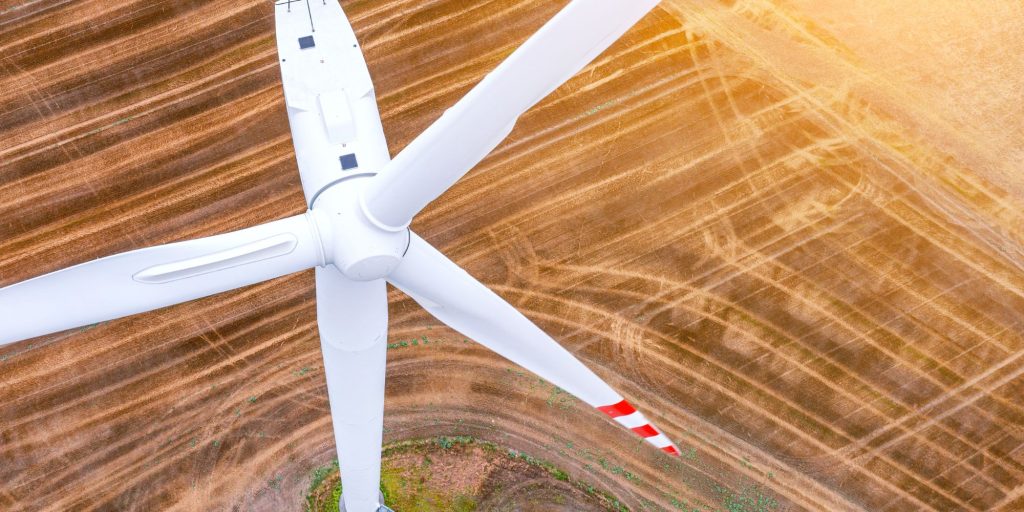
Dakota Resource Council helps two counties garner huge economic benefits through an agreement it proposed for a wind farm in North Dakota
By Ted Brewer, WORC communications director
In 2008, a group of landowners in the township of New Rockford, North Dakota, approached the New Rockford Area Betterment Corporation (NRABC), a nonprofit community development organization, with a proposal to attract a wind farm to Eddy County, the county in which the township is located. A wind farm had just been built in adjoining Benson County, and with it came a host of economic benefits. The landowners wanted the same for Eddy County.
The NRABC agreed it was a good idea, and convinced the city to invest several hundred thousand dollars in wind monitoring, assembling the parcels of land needed for the farm, arranging the necessary lease options with the landowners, and other work that goes into planning a wind farm. The plan stalled for several years as the U.S. experienced and recovered from the financial crisis, but it regained momentum a few years ago when the city issued a call for proposals to potential developers for the project it had already laid the groundwork for. PRC Wind, a wind development company in Minneapolis, agreed to take on the project.
“Because New Rockford had control over the proposal, they had this extra leverage,” says Mike Graalum, clean energy organizer for Dakota Resource Council (DRC), one of WORC’s nine member groups. “They were able to negotiate all the kinds of things you never get out of a wind developer. For instance, they got voluntary one-mile setbacks from houses, cemeteries, and churches, whereas North Dakota requires only a 300-meter setback.”
“New Rockford basically determined its own wind farm development,” Scott Skokos, executive director of DRC, says. “That’s not what normally happens.”
Keep up to date with grassroots organizing in the West with WORC’s newsletter.
Once the contract had been signed, PRC applied for and, in early 2025, received the official permit it needed from the grid provider, Midwest Independent System Operator. Around this time, as the wind farm was beginning to attract media attention, Graalum recognized an opportunity for NRABC to negotiate a community benefit agreement (CBA) with PRC.
CBAs have previously been applied to a handful of other wind farm developments in the U.S., including the Block Island Wind Farm off the coast of Rhode Island, the country’s first offshore wind farm. The original developer of the wind farm, Deepwater Wind, agreed to a CBA with New Shoreham, a town on Block Island whose economy largely depends on the tourism the island brings, which would be impacted by the wind farm.
According to World Resources Institute, the agreement stipulated that “Deepwater Wind would build a transmission line to transmit wind power and link Block Island to the mainland for the first time and co-install a fiber optic cable to bring broadband internet to the island. [New Shoreham] secured a host of other benefits in the agreement, including infrastructure improvements, a project labor agreement, and two $1.25-million donations to the local historical society and the Southeast Lighthouse Foundation.”
“The CBA is a straightforward tool we can use to incentivize the development of clean energy and bring real, lasting benefits to rural communities in need of an economic boost.”
-Mike Graalum, Dakota Resource Council organizer
Graalum met with staff at NRABC and presented the outlines of what a CBA could look like for Eddy County, which included dividends for “non-participating landowners,” that is, people whose land adjoins parcels used in the wind farm development but are still impacted by its footprint. Staff at NRABC liked what they heard and decided to approach PRC with a proposal for an agreement benefiting New Rockford.
PRC was open to the idea and agreed to negotiate a CBA with NRABC and Dakota Resource Council for the first phase of PRC’s two-phase, 43,000-acre wind farm development, dubbed Flickertail Wind, which will be located in Eddy and adjacent Wells counties.
Late last year, PRC signed the community benefits agreement with NRABC. The agreement adds to the approximately $1.2 million in tax revenue Flickertail Wind is expected to earn for Eddy and Wells counties every year, and to the millions of dollars in dividends to landowners.
The CBA stipulates that Flickertail Wind pays $1 million in one-time contributions to NRABC for a variety of economic development and environmental conservation initiatives throughout the two counties, including $100,000 to renovate the 100-year-old Rockford Theatre (whose roof collapsed in 2002 under a heavy snowpack). It also stipulates annual payments to NRABC and non-participating landowners based on a formula tied to Flickertail’s megawatt capacity. That will amount to over $400,000 a year for the next 25 years. Each non-participating landowner will also receive around $100,000 in dividends over that same period. In total, the one-time and annual payments stipulated in the CBA could amount to nearly $13 million for the NRABC and non-participating landowners over the next 25 years.
“This is an unprecedented opportunity for a rural community like ours, both in scope and long-term impact, to secure an agreement of this magnitude.”
-Amanda Hegland, NRABC Director
“This is an unprecedented opportunity for a rural community like ours, both in scope and long-term impact, to secure an agreement of this magnitude,” NRABC Director Amanda Hegland told the New Rockford Transcript. “This is truly a landmark moment for our region.”
Graalum has researched CBAs involving renewable energy projects across the country and determined that the Flickertail CBA is one of the ten largest ever signed in the U.S., and by far the largest signed in the state of North Dakota.
“The CBA is a straightforward tool we can use to incentivize the development of clean energy and bring real, lasting benefits to rural communities in need of an economic boost,” Graalum says.
“Dakota Resource Council can be extremely proud of the crucial role we played in the creation of the Flickertail CBA,” Skokos says. “It offers us an enormous opportunity to work with other communities throughout the state in welcoming clean energy projects, and it sets standards for those communities to get the economic benefits they need and deserve from the developers.”


Learn more:
North Dakota Legislators Try to Bail Out the Dying Coal Industry While Penalizing Wind Energy
Yes, I want to help WORC elevate Western voices and hold decision-makers accountable!